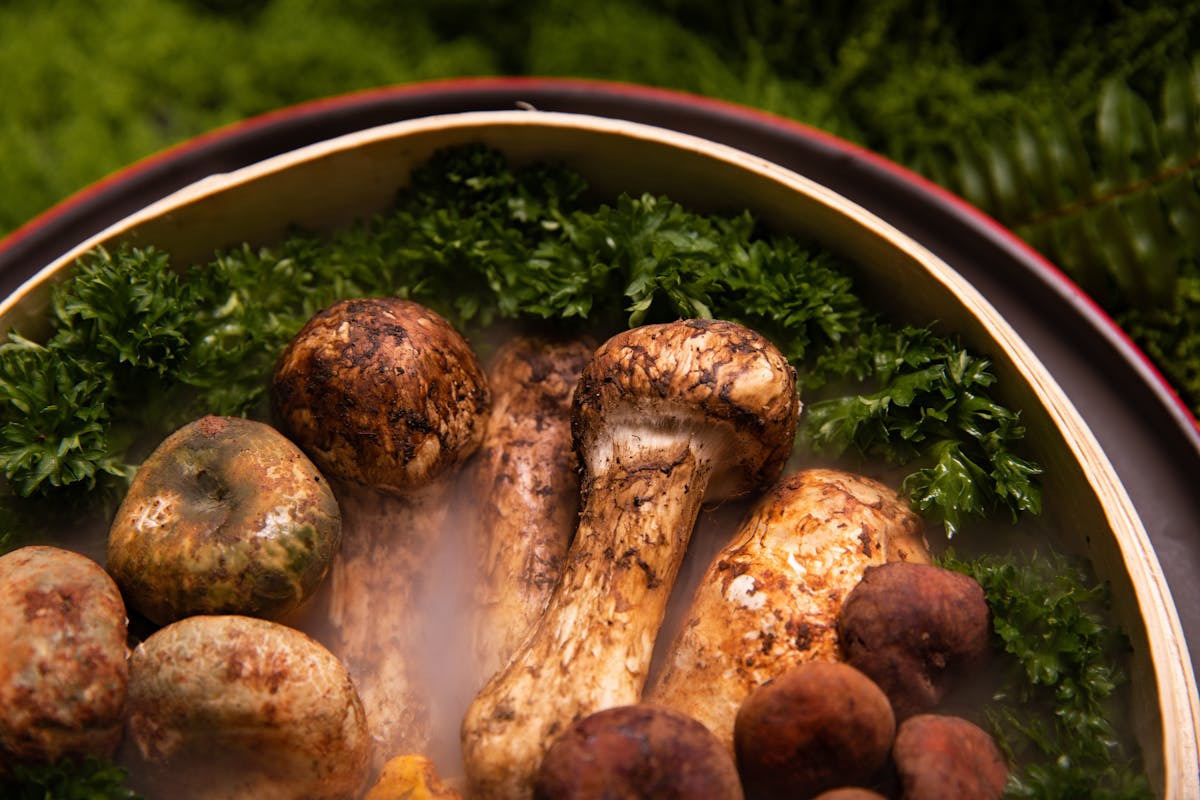
Few mushrooms carry the cultural weight of the matsutake (Tricholoma matsutake). Prized across East and Southeast Asia for centuries, this pine-forest fungus occupies a unique position: simultaneously a luxury culinary ingredient, a symbol of seasonal tradition, and an increasingly studied subject in functional food science. While research is still in relatively early stages, a growing body of laboratory and preclinical work suggests that matsutake may offer biological activities worth taking seriously.
Cultural and Historical Context
In Japan, matsutake has been celebrated in poetry, gift-giving rituals, and autumn cuisine for more than a thousand years. The mushroom’s name translates roughly to “pine mushroom,” reflecting its ectomycorrhizal relationship with specific conifer species, particularly Japanese red pine (Pinus densiflora). This relationship makes matsutake notoriously difficult to cultivate commercially; nearly all supply comes from wild harvesting, which contributes to its scarcity and high market value.
In Korean and Chinese traditions, matsutake likewise holds a place of cultural esteem. In Korea, it is associated with the Joseon dynasty and continues to be gifted during Chuseok (harvest festival). In China, wild matsutake from Yunnan province commands premium prices in domestic and international markets. This cultural significance has helped sustain interest in the mushroom even as global wild populations face pressure from habitat loss and climate shifts that affect host pine ecosystems.
Nutritional and Phytochemical Profile
Matsutake contains a diverse array of bioactive compounds that researchers have begun to characterize in detail. A 2023 comprehensive review published in Critical Reviews in Food Science and Nutrition examined the myochemical profiles of T. matsutake, identifying proteins and amino acids, fatty acids, nucleic acid derivatives, polysaccharides, minerals, volatile aromatic compounds (including the characteristic 1-octen-3-ol and methyl cinnamate), phenolic compounds, and steroids.[1]
The volatile compounds give matsutake its distinctive spicy, cinnamon-like aroma, which is central to its culinary identity. Beyond flavor, the polysaccharide fraction, particularly beta-glucans, has attracted the most scientific interest. These carbohydrate chains appear to interact with immune receptors and may influence multiple biological pathways, including those governing inflammation and cellular defense.
The same 2023 review noted that the bioactive substances in matsutake appear to exert their effects primarily through regulation of body immunity and the redox system, with NF-kB signaling and downstream cytokines such as TNF-alpha and IL-6 identified as key molecular mechanisms.[1] The authors also noted involvement of MAPK, PI3K-Akt, and JAK-STAT pathways in various studied effects.
Polysaccharides and Immune Modulation
One of the more studied areas involves matsutake polysaccharides and their potential immunomodulatory properties. A 2013 study published in Pharmacognosy Magazine isolated a novel polysaccharide fraction (designated TMP-A) from T. matsutake and examined its antimicrobial, antitumor, and immune activities in laboratory and animal models.[2]
In that study, TMP-A demonstrated measurable antibacterial activity against Micrococcus lysodeikticus. In mouse models bearing S180 tumor cells, the polysaccharide fraction showed inhibitory activity that the researchers attributed, at least in part, to stimulation of cell-mediated immune responses, including promotion of lymphocyte proliferation and macrophage activation.[2] The authors concluded that TMP-A represents a potential source of natural broad-spectrum immunomodulatory compounds, while noting that further research would be required to clarify mechanisms and translate findings to clinical contexts.
It is important to note that animal and cell-line studies, while informative, do not establish efficacy in humans. This remains an area where human clinical trial data is largely absent, and claims about immune benefits in people cannot be made from preclinical data alone.
Antioxidant and Antifatigue Properties
Oxidative stress, in which an imbalance between reactive oxygen species and antioxidant defenses occurs, is implicated in aging, fatigue, and various chronic conditions. Matsutake has been evaluated in this context as well. A 2020 study published in the Journal of Food Science investigated the antifatigue effects of cookies fortified with T. matsutake powder in mice, using an exhaustive swimming test as the primary endpoint.[3]
Mice receiving the matsutake-fortified cookies showed prolonged swimming endurance and significantly higher levels of muscle and liver glycogen compared to controls. Serum lactic acid and urea nitrogen, markers typically associated with physical fatigue, were reduced. The study also reported improved activity of superoxide dismutase and glutathione peroxidase, two important antioxidant enzymes, alongside decreased malondialdehyde, a marker of oxidative damage.[3] The researchers concluded that matsutake may support energy storage and antioxidant capacity, suggesting a basis for further investigation into its role in fatigue-related outcomes.
Again, these findings are drawn from animal models. Extrapolating them directly to human physical performance requires caution and validation through clinical research.
Anticancer Research: Preliminary Findings
The 2023 review in Critical Reviews in Food Science and Nutrition also summarized emerging anticancer research on matsutake.[1] The NF-kB, MAPK, and PI3K-Akt signaling pathways that matsutake compounds appear to modulate are known to play roles in cancer cell proliferation and survival. Laboratory studies have shown effects of matsutake extracts on various cancer cell lines, but the authors of the review themselves emphasized that most studies have only investigated dosage and inhibition rates in cell lines, and more extensive work needs to focus on specific molecular mechanisms in future research.
This is an area where significant caution is warranted. Cell-line results frequently do not translate into clinical benefit, and no clinical evidence currently supports the use of matsutake as a cancer treatment or preventive agent in humans.
How Matsutake Compares to Other Functional Mushrooms
Matsutake occupies a somewhat different niche than the more widely studied functional mushrooms. For comparison, mushrooms like reishi, lion’s mane, and turkey tail have accumulated considerably more clinical and human trial data. Matsutake’s research base remains largely preclinical, though the biochemical mechanisms being studied (polysaccharide-mediated immune modulation, antioxidant activity, NF-kB pathway regulation) are consistent with those observed in better-studied species.
Its unique aromatic volatiles and amino acid profile give it a distinct culinary identity that sets it apart from, say, the more supplement-oriented reishi or chaga. For those interested in the broader landscape of functional fungi, understanding what beta-glucans are and how they contribute to mushroom bioactivity provides useful grounding for interpreting matsutake research as well.
Availability, Sustainability, and Sourcing Considerations
Because matsutake forms obligate symbiotic relationships with host trees and cannot currently be cultivated at commercial scale, wild harvest remains the primary source. This creates several considerations for consumers. Wild-harvested products are subject to natural variability in bioactive compound concentrations. Seasonal availability is limited, and global supplies have declined in some regions due to loss of mature pine forest habitat and changes in soil conditions linked to climate patterns.
Consumers interested in matsutake supplements or extracts should look for products that disclose sourcing regions, harvest methods, and ideally third-party analysis for compound verification. As with all mushroom supplements, the distinction between mycelium-only products and those derived from the fruiting body can affect the bioactive profile present in the final product.
What the Research Does and Does Not Show
The emerging science on matsutake is genuinely interesting. Preclinical studies suggest plausible mechanisms through which this mushroom may support antioxidant activity, immune function, and physical endurance markers. Its polysaccharide content, particularly beta-glucan fractions, aligns with compounds that have demonstrated biological activity in related fungi species with more extensive research records.
However, the research base for matsutake remains limited relative to mushrooms like reishi or turkey tail. The absence of human clinical trials means that specific health claims cannot be responsibly made at this time. The cultural significance of matsutake is well established; its role as a functional supplement in human health is still being explored and requires further clinical investigation before definitive conclusions can be drawn.
References
- [1] Zhou Y, El-Seedi HR, Xu B. Insights into health promoting effects and myochemical profiles of pine mushroom Tricholoma matsutake. Crit Rev Food Sci Nutr. 2023;63(22):5698-5723. https://pubmed.ncbi.nlm.nih.gov/34985354/
- [2] Hou Y, Ding X, Hou W, et al. Anti-microorganism, anti-tumor, and immune activities of a novel polysaccharide isolated from Tricholoma matsutake. Pharmacogn Mag. 2013;9(35):244-9. https://pubmed.ncbi.nlm.nih.gov/23930009/
- [3] Ma N, Tao H, Du H, et al. Antifatigue effect of functional cookies fortified with mushroom powder (Tricholoma Matsutake) in mice. J Food Sci. 2020;85(12):4389-4395. https://pubmed.ncbi.nlm.nih.gov/33159467/
This article is for informational purposes only and does not constitute medical advice. Always consult a qualified healthcare provider before starting any supplement.